
Brain Wiring and Nervous System
Where the language of science touches the music of harmony, and the nervous system is understood not as disorder, but as living resonance.
Scientific research highlights measurable neurological differences in nonspeaking autistic children, from patterns of hyper- and hypo-connectivity to cerebellar rhythm, polyvagal responses, and sensory integration. Traditionally, these are described as deficits. But seen through a harmonic lens, they reveal another kind of order: a nervous system tuned for resonance rather than efficiency.
Connectivity may appear imbalanced, yet it creates pathways for perceiving patterns and vibrations others filter out.
Cerebellar timing may diverge from social rhythm, yet carries an inner geometry of movement and pause.
Polyvagal sensitivity may bring quick shifts between hyperarousal and shutdown, yet functions as an antenna for coherence in the environment.
Sensory processing may overwhelm, yet offers a broader spectrum of perception, where light, sound, and touch arrive with their harmonic overtones intact.
Taken together, these traits suggest not a broken system but a different instrument. Where neurotypical wiring seeks regulation and balance, non-speaking autistic wiring seeks depth and resonance. These children are not “lacking” speech or regulation; they embody a distinct tuning of the human nervous system, one that holds, reflects, and reveals the subtler patterns of life.
-
Scientific studies show that autistic brains often display both hyper-connectivity (too many active neural connections in some regions) and hypo-connectivity (fewer in others).
Harmonic Perspective:
This isn’t “dysfunction,” but rather a different tuning of the lattice. Hyper-connectivity may allow non-speaking autistics to sense patterns, rhythms, and unseen energies that neurotypical brains filter out. Hypo-connectivity creates stillness in certain areas, allowing deeper focus on subtle vibrations. It’s a field that is specialised for depth rather than balance, like a string tuned tighter or looser to create a unique resonance.
-
The cerebellum, long known for movement and balance, also shapes timing, rhythm, and aspects of language. Autistic differences here often affect speech and motor planning.
Harmonic Perspective:
The cerebellum acts like the body’s metronome. When tuned differently, autistic children may move, gesture, or express in ways that don’t match neurotypical rhythm. But from the harmonic view, they are embodying a different cosmic rhythm, one aligned with inner geometries rather than outer social timing. Their silence or delayed speech is not absence but holding a deeper harmonic pause in the collective field.
-
Research: Frontiers in Psychology
Polyvagal research shows that autistic children often toggle quickly between states of hyperarousal (fight/flight) and shutdown (freeze) because their nervous systems are more finely attuned to environmental cues of safety/danger.
Harmonic Perspective:
This reflects their role as guardians of coherence. Their nervous systems act like sensitive antennae for the collective lattice, immediately detecting disharmony in environments, WiFi, lights, sounds, or emotional incoherence in others. Their “shutdowns” are not failures, but protective retreats into the harmonic core, allowing them to stabilise the field until balance can be restored.
-
Research: Oxford Brain Journal
Studies show that sensory signals (sound, light, touch, etc.) are processed differently in autistic brains, sometimes amplified, sometimes muted, sometimes cross-linked.
Harmonic Perspective:
Instead of a disorder, this is an expanded sensory spectrum. They are experiencing not just the physical input, but the harmonic overtones of it. A light isn’t just “on” or “off”, it’s felt as waves, flickers, and frequencies. A sound carries not only tone but also the emotional imprint of the speaker. Their “sensory overload” is, in truth, sensory wholeness, too much for ordinary nervous systems, but natural for theirs.
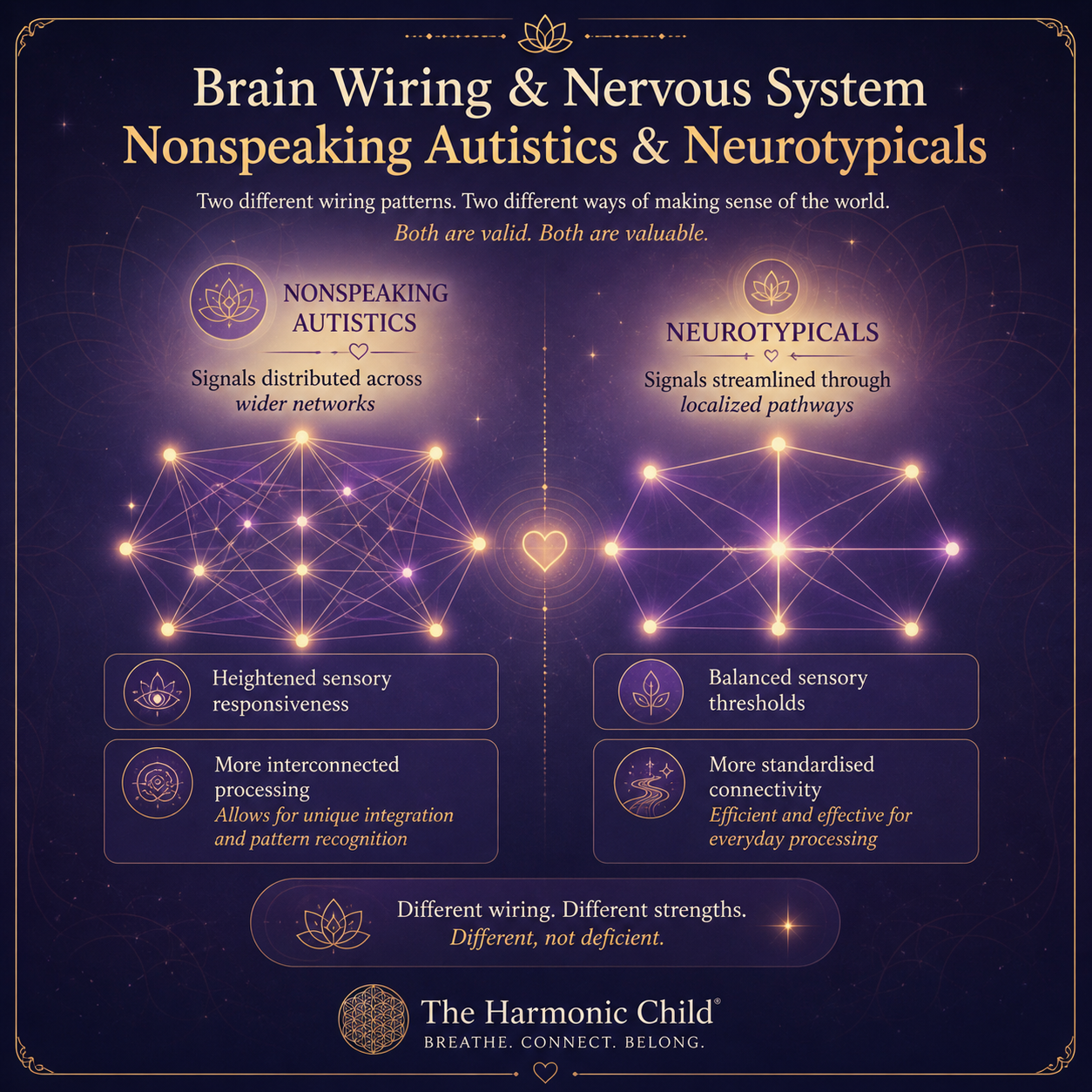
This diagram compares how the brain and nervous system process information in nonspeaking autistic children and neurotypical children.
On the left, the autistic network shows signals distributed across wider pathways. This broader routing can result in heightened sensory responsiveness and more interconnected processing. While it may contribute to sensory overwhelm, it also allows for unique integration of information and pattern recognition.
On the right, the neurotypical network depicts signals travelling through more localised, streamlined pathways. This produces balanced sensory thresholds and a more standardised connectivity pattern, reducing the likelihood of overload but also limiting the depth of certain cross-network integrations.
The image isn’t about “better” or “worse” wiring. Instead, it illustrates two different organisational logics of the nervous system: one emphasising breadth and intensity, the other efficiency and regulation. Both carry strengths and challenges, depending on context.
American Psychiatric Association. (2013). Diagnostic and statistical manual of mental disorders (5th ed.). Arlington, VA: American Psychiatric Publishing.
References
Atypical Connectivity (hyper/hypo)
Kana, R. K., Libero, L. E., Hu, C., Deshpande, H. D., & Colburn, J. S. (2014). Functional brain networks and “underconnectivity” in autism: A detailed review of evidence from resting-state fMRI. Frontiers in Human Neuroscience, 8, 263. https://doi.org/10.3389/fnhum.2014.00263
Cerebellar Differences (coordination, language)
Stoodley, C. J., & Schmahmann, J. D. (2010). Evidence for topographic organisation in the cerebellum of motor control versus cognitive and affective processing. NeuroImage, 49(4), 2105–2115. https://doi.org/10.1016/j.neuroimage.2009.09.030
Polyvagal Theory (safety & shutdown)
Porges, S. W. (2018). Polyvagal Theory: A biobehavioral journey to sociality. Frontiers in Psychology, 9, 1745. https://doi.org/10.3389/fpsyg.2018.01745
Sensory Integration (different wiring)
Baron-Cohen, S., Ashwin, E., Ashwin, C., Tavassoli, T., & Chakrabarti, B. (2009). Talent in autism: Hyper-systemising, hyper-attention to detail and sensory hypersensitivity. Philosophical Transactions of the Royal Society B: Biological Sciences, 364(1522), 1377–1383. https://doi.org/10.1098/rstb.2008.0337